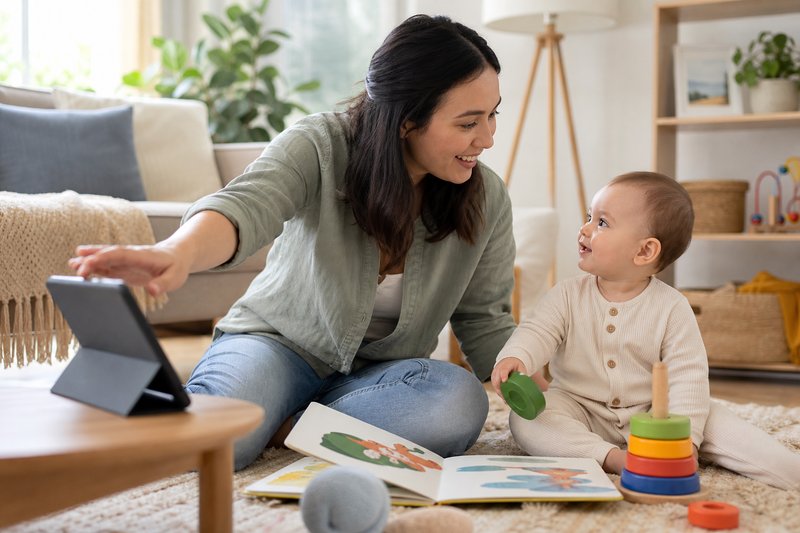
AI-generated editorial illustration; not a contest entrant or winner.
Screen Time and Babies: What the Official Guidelines Say
Screens are everywhere, and the advice can feel guilt-inducing. Here is what the AAP and WHO actually recommend for babies and toddlers, in plain language.
A quick note
This is a general overview of published guidance, not medical or developmental advice for your specific child. Recommendations evolve as new research emerges. Your pediatrician can help you apply them to your family's situation.
If you have ever propped up a phone to finish a phone call, or handed over a tablet to survive a long flight, this article is not here to make you feel bad. Screens are part of modern life. What helps is understanding what the major health bodies actually recommend — and why — so you can make choices that fit your family instead of chasing an impossible standard.
What the Major Guidelines Recommend
American Academy of Pediatrics (AAP)
The AAP generally advises avoiding screen media (other than video chatting) for children younger than about 18 months, and introducing high-quality programming slowly and together with a caregiver for toddlers older than that. The AAP encourages families to build their own "Family Media Plan."
🔗 healthychildren.org (search "media use" and "Family Media Plan")
World Health Organization (WHO)
In its guidance on physical activity and sedentary behavior for young children, the WHO recommends no screen time for infants under 1, and limited, supervised screen time for children aged 2 and up, alongside plenty of active play and adequate sleep.
🔗 who.int (search "physical activity sedentary behaviour under 5")
Notice what these have in common: the emphasis is less on a stopwatch and more on what babies do instead of screens — face-to-face interaction, movement, play, and sleep. Video chatting with a grandparent is treated differently from passive viewing precisely because it is interactive and social.
Why the First Two Years Get Special Attention
Early childhood is a period of rapid brain development, and very young children learn primarily through real-world, back-and-forth interaction — what researchers often call "serve and return." Guidelines single out the under-two window because time spent passively watching is time not spent on the hands-on, face-to-face experiences that support early language and social development. This is also why tummy time and floor play get so much emphasis in the first year.
Realistic Tips for Real Families
- Co-view when you can. Watching together and talking about what is on screen turns passive viewing into a shared, more interactive experience.
- Protect meals and the hour before sleep. Two of the easiest screen-free zones to protect are mealtimes and the wind-down before bed, which also supports better sleep routines.
- Choose quality over quantity. Slow-paced, age-appropriate content is easier for young children to follow than fast, ad-heavy programming.
- Model the behavior. Children notice adult screen habits. Narrating "I'm putting my phone away now" does more than a rule ever will.
- Make a plan, not a ban. A simple written Family Media Plan reduces the daily negotiation and helps caregivers stay consistent.
💡 Give yourself grace
Guidelines describe an ideal, not a report card. A hard day with more screen time than usual does not undo months of reading, singing, and play. Consistency over time matters more than any single afternoon.
What to Ask at Your Next Checkup
- Is my child meeting the communication and play milestones you'd expect for this age?
- Are there specific activities you'd suggest we do more of?
- How should I think about video calls with family versus other screen use?
Keep Reading
Screen habits are one small part of a rich early environment. These guides go deeper on the hands-on side of development:
And when your little one does something screen-free and wonderful, that is exactly the kind of moment worth sharing in our monthly photo contest.
Disclaimer: This article summarizes publicly available guidance for general information only and is not medical or developmental advice. Recommendations from bodies such as the AAP and WHO may change as research evolves. Every child develops differently. Consult your pediatrician for advice specific to your child. Baby of the Month is not a medical provider and is not liable for how this information is used.
Your Baby Could Be Our Next Winner!
Cash Prize in monthly prizes • FREE entry • Real winners • Optional paid votes